When a second battery actually helps (and when it doesn’t)
Most people reach for a second battery after seeing headlights dim or bass hit soft, but that upgrade only solves one specific problem: short bursts of extra energy when the alternator can’t keep up for a moment. If you listen loud with the engine running and your voltage mostly stays healthy, a second battery can smooth peaks and reduce brief dips, especially in stop-and-go traffic or at idle.
It does not create power. If your alternator is undersized for your amp’s real demand, two batteries simply take longer to drain, then require more time to recharge. That can mean chronic low voltage, hotter charging components, and a higher chance of a no-start later. It also adds cost, weight, mounting work, and real safety requirements (proper fusing and isolation), so it’s best used deliberately, not as a default fix.
Symptoms that push people toward a second battery

You usually start thinking “second battery” after you notice repeatable electrical sag: headlights and dash lights pulsing with bass hits, the amp going into protect at higher volume, or bass that sounds strong for a second and then compresses. Another common trigger is a drop in performance at idle—fine while cruising, then weak at stoplights—because alternator output is typically lower at low RPM.
Hard starts are the other big one. If the car cranks slower after a long drive with loud music, or you can’t restart after sitting with the system playing for 10–30 minutes, you’re seeing a capacity problem (engine off) or a charging problem (engine on), and the fix is not the same. Also watch for a battery that tests “good” but keeps going flat, frequent jump-starts, or a persistent “low voltage” reading on an amp’s voltage display. The practical catch: adding a second battery can hide the symptom while increasing charging load and wiring complexity.
Your system’s demand: amp power, listening habits, and duty cycle
Picture two people with the same “1000W” amp: one listens at moderate volume on the highway, the other demos bass-heavy tracks at stoplights with the gain set hot. Their electrical demand isn’t remotely the same, because an amp’s real draw is tied to average output over time (duty cycle), not the biggest number on the box. A rough reality check is to estimate current as watts divided by voltage, then adjust for amp type: a 1000W-class amp can still pull well over 100A during hard peaks, and a less efficient full-range amp can ask for even more for the same audible loudness.
Your habits decide whether that becomes a “momentary dip” or a constant drain. Long idle sessions, short trips where the alternator barely recharges, and engine-off listening all push you toward needing more battery capacity or charging capability. The practical constraint is heat and runtime: high average current means hotter wiring, more voltage drop, and much less time before the system (or starting battery) is depleted.
Why the alternator matters more than most people think
You can think of the alternator as the “income” for your electrical system. With the engine running, it should cover the car’s base loads (fuel pump, fans, ECU, lights) plus whatever your amp needs on average. If it can’t, the batteries become the buffer and you’ll see voltage slide from the mid‑14s down into the 13s, then high‑12s. That’s when bass gets soft, amps clip sooner, and protect modes show up even though the batteries are technically fine.
The confusing part is that alternator ratings are usually at higher RPM and ideal conditions. At idle, output can be dramatically lower, which matches the “fine cruising, weak at stoplights” symptom. A second battery may make those dips less obvious, but it doesn’t change the alternator’s ceiling; it just gives the alternator more to recharge afterward. That added recharge demand can keep voltage low longer, run the alternator hotter, and shorten its life if you’re consistently asking more than it can deliver.
Before adding a battery: Big 3 wiring, grounds, and voltage checks
You can save yourself a lot of money and frustration by making sure the stock paths for current are actually capable of carrying what your amp is asking for. The “Big 3” upgrade (alternator positive to battery positive, battery negative to chassis, and engine block to chassis) is basically removing bottlenecks in the factory wiring that show up as voltage drop under bass hits. A weak ground is especially common: corrosion, paint under a ring terminal, or a small factory strap can turn “not enough electrical” into “not enough connection.” The limitation is that thicker wire doesn’t increase alternator output; it only helps you keep more of the voltage you already have.
Do a quick voltage check before you buy parts. Measure at the battery with the engine idling (no music), then again with headlights and the system playing loud. If voltage falls into the high‑12s/low‑13s while running, you’re looking at a charging or voltage-drop problem, not just battery capacity. If the battery reads normal but the amp sees much lower, your wiring and grounds are the first fix.
Second battery options: where to mount, how to isolate, how to fuse
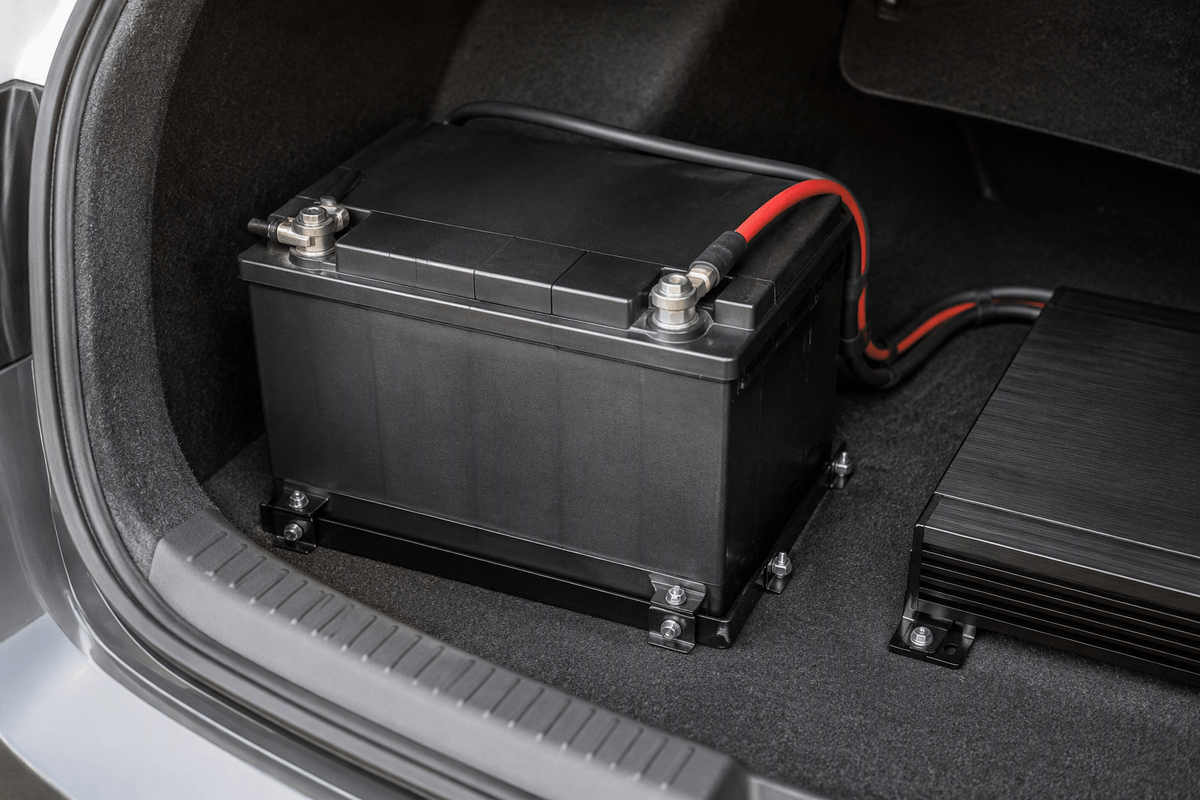
A second battery choice starts with where it lives. Under-hood mounting keeps cable runs short and voltage drop lower, but it adds heat exposure and crowding, and many modern bays simply don’t have safe space. A trunk-mounted battery is common for sound builds because it can sit near the amp, but it requires a solid hold-down (crash safety), ventilation if it’s not a sealed AGM, and careful routing so the cable can’t chafe through on metal.
Isolation is what prevents “great bass, dead car.” If you want engine-off play time without risking the starting battery, use a battery isolator or an automatic charging relay (ACR) so the alternator charges both when running, but the audio battery can’t backfeed and drain the starter when parked. Plan for the downside: isolators and long cables can introduce small voltage loss, and any added hardware is another failure point if installed poorly.
Fusing isn’t optional. Fuse the positive cable within about 6–12 inches of each battery, sized to protect the wire (not the amp), and use the same gauge for the return path if you run a dedicated negative cable. Most fires in “two battery” installs start as a simple short to chassis that wasn’t fused at the source.
Alternatives that may fit better: capacitors, bigger battery, or HO alternator
If your main complaint is brief dimming on hard hits, a capacitor can help clean up very fast transients, but it’s not a substitute for a weak charging system. It has to recharge from the same alternator and wiring, so if voltage is already living in the low‑13s/high‑12s while driving, a cap mostly masks the symptom and can make you think you “fixed” it.
A single bigger battery (or better battery chemistry) often makes more sense than adding a second: less wiring, less failure points, and you still gain reserve for short peaks and limited engine-off listening. The real fix for consistent low voltage with the engine running is usually a high‑output alternator. It costs more up front and may require a shorter belt, heavier charge wire, and better cooling, but it actually raises the system’s “income” instead of just adding more “savings.”
A simple decision checklist for your specific build
If you mainly listen with the engine running and your battery voltage stays in the mid‑13s to mid‑14s at cruise, start with the Big 3, clean grounds, and a bigger single battery before adding complexity. If voltage drops into the high‑12s/low‑13s while driving loud (especially at idle), prioritize alternator capacity; a second battery won’t raise running voltage. If you need 10–30+ minutes of engine‑off play time, a second battery can help, but only with proper isolation and source fusing at both batteries. If your only issue is split‑second dimming, consider a cap after wiring is solid.