What a subwoofer actually changes in your listening
You usually notice the gap a subwoofer fills on the sounds your main speakers hint at but can’t fully deliver: the lowest notes in a kick drum, the weight of a bass guitar, the deep rumble in movie effects, and the “thump” that makes gameplay feel physical. A good sub doesn’t just make things louder; it takes strain off your main speakers so midrange can sound cleaner at the same volume. The trade-off is that bass is the hardest part of audio to control in a real room. Placement, settings, and even your floor can turn “deeper” into “boomy” fast.
Start with your use case: music, movies, gaming, or mixed
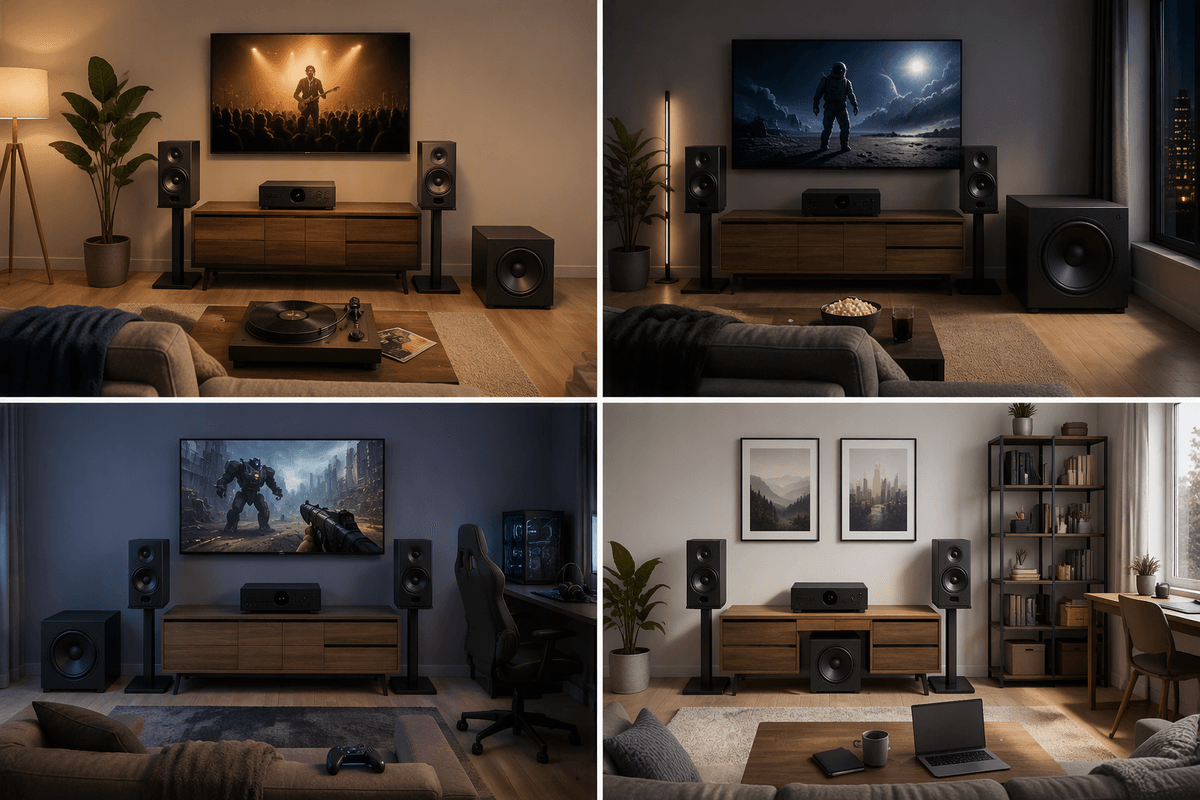
If you mostly listen to music at moderate volumes, a subwoofer is about balance and definition, not shaking the couch. You’ll likely prefer a smaller, tighter-sounding sub that can blend in without calling attention to itself, because “one-note” bass gets old fast on songs you know well. For movies, the value is more obvious: modern soundtracks often put big energy into very low frequencies, and a sub is what turns explosions and distant thunder from “heard” into “felt.”
For gaming, bass adds impact and positional cues, but it can also mask subtle details if it’s set too hot. Mixed use is where most people land, which usually means choosing settings you can live with daily, not just the most impressive demo. A practical constraint: the best movie-style bass often requires more output (and space) than your room, budget, or neighbors will tolerate.
Your room and neighbors might decide for you
You can buy a great subwoofer and still end up disappointed if the room fights it. Bass waves are long, so small rooms often create big peaks and nulls: one seat gets chesty boom, another gets thin bass, even at the same volume. Hard surfaces (bare floors, big windows) can make that boom linger, while thick rugs and furniture can help tame it. If your setup is on a suspended wood floor, a sub can also physically transmit vibration in ways that a concrete slab won’t.
Neighbors matter because low frequencies travel through walls and floors more easily than mids and highs. In an apartment or shared walls, the “fun” setting for movies may be the “complaint” setting next door. That doesn’t mean you can’t use a sub, but it pushes you toward smaller sealed models, careful placement, isolation pads, and being realistic about late-night volume.
How to tell if your current speakers already cover enough
Most people don’t need measurement gear to get a decent read on their speakers. Put on a few tracks you know well (kick drum, bass guitar, synth) and a movie scene with steady low rumble, then listen at your normal volume—not a quick “show-off” level. If the bass sounds present but gets thin when you turn it down, or it only feels satisfying when you crank the volume, your speakers are likely running out of low-end headroom. Another clue is strain: the sound gets congested or harsh when bass-heavy moments hit, because the speakers are trying to do deep bass and midrange at the same time.
On the other hand, if you’re already getting clean, even bass at your seat and you rarely feel like you’re “missing” anything, a sub may be a smaller upgrade than you expect. Many towers and larger bookshelves can be “enough” for music, especially in smaller rooms. The catch is consistency—walk around the room. If bass changes dramatically from spot to spot, the limitation may be the room, not the speakers, and a sub won’t automatically fix that without placement and tuning effort.
Choosing the right kind of sub: size, sealed vs ported
You’ll see subwoofers marketed by driver size (8", 10", 12") and by box design (sealed vs ported), but the real question is how much low-frequency output you need at your listening distance. In a small-to-medium room, a good 10-inch is often the “safe bet”: enough weight for movies and games without demanding huge floor space. Bigger drivers can help with output and lower extension, but they’re harder to place discreetly and easier to overdo in apartments.
Sealed subs usually sound “tighter” and are more forgiving in tricky rooms because their roll-off is smoother, which can make integration with bookshelves or small towers easier. Ported subs tend to deliver more output per dollar, especially in the deep-bass region that makes action movies impressive, but they can sound a bit looser if they’re pushed hard or placed badly. A practical constraint: the ported designs that dig deep are often physically large, and that size can limit your placement options more than you expect.
Integration is the hidden cost: placement, crossover, calibration
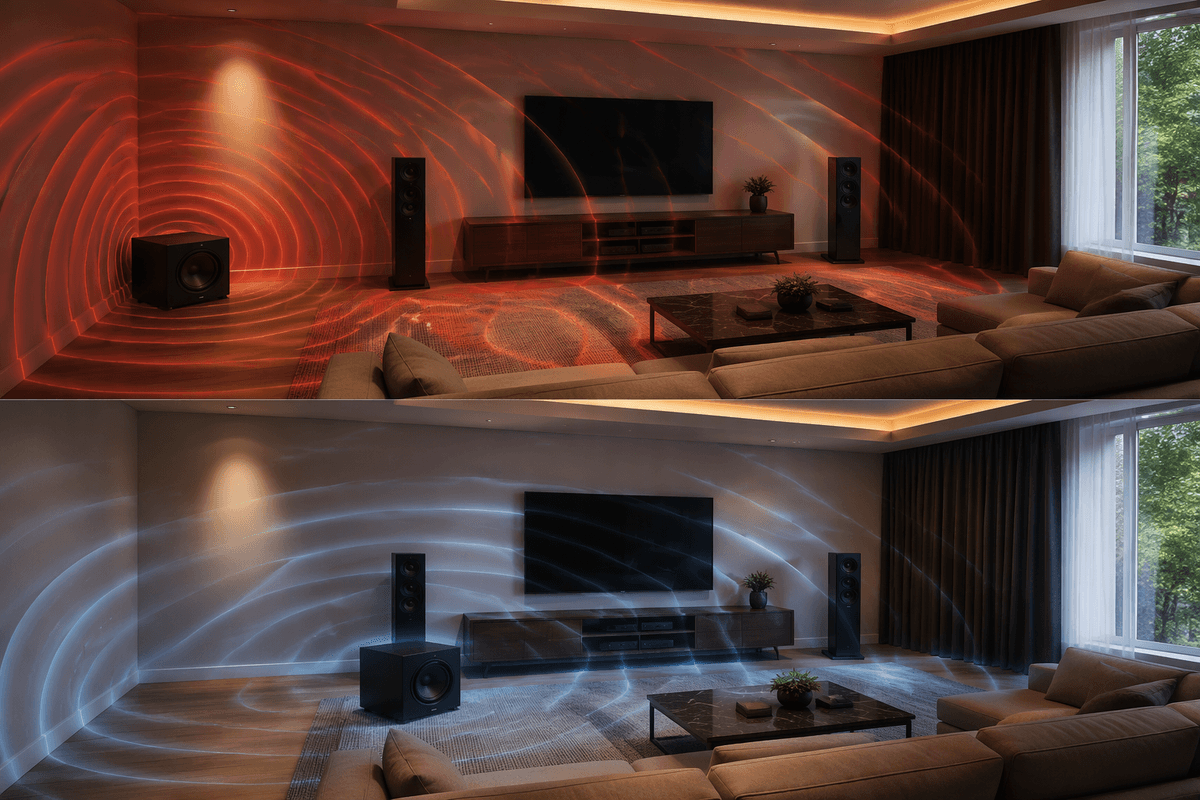
You can spend good money on a sub and still feel underwhelmed if it isn’t integrated well. Placement is the first lever: move the sub a couple feet and you can change bass from punchy to boomy, or from “present” to strangely missing at your seat. A practical method is the “sub crawl”: put the sub where you sit, play a bass-heavy loop, then walk the room to find spots where bass sounds even—those are good candidates for the sub’s actual location.
Crossover and level are the second lever. Set the crossover too high and the sub becomes easy to localize; too low and you leave a gap where kick drums and bass lines lose body. If you have an AV receiver, start with its auto-setup, then sanity-check by ear: voices shouldn’t thicken, and bass notes shouldn’t all sound the same. Calibration takes time, and wireless kits can add cost and a bit of latency or noise, so “easy placement” isn’t always free.
Budget realities: what improvements you get at each tier
If you’re shopping under about $200, the main win is “more bass than before,” not necessarily better bass. These subs can add welcome weight for casual movies and games, but they often run out of clean output quickly, and room boom can be harder to tame because you have fewer controls and less headroom. Expect bigger improvements in a small room than a large one.
In the roughly $200–$500 range, you usually get the first truly meaningful step up: deeper extension, noticeably cleaner impact, and enough control (phase, better crossover behavior, sometimes room EQ via your receiver) to blend with real-world speakers. This is where music benefits start to show up, not just action scenes.
Above about $500, you’re mostly paying for effortless output and lower distortion—bass that stays controlled as you turn it up, plus better consistency across seats if you add a second sub later. The catch is practical: bigger cabinets take space, and chasing “the last 10%” can mean extra spend on calibration tools, isolation, or room treatment.
So, is it worth it? A quick decision checklist
If you regularly watch action movies, play bass-heavy games, or listen to music where kick and bass feel “suggested” unless you turn up the volume, a sub is usually worth it—especially if your current speakers sound strained during big low-end moments. If you’re in an apartment, listen late at night, or can’t place a box away from corners, the value drops unless you’re willing to keep levels conservative and add isolation.
Quick checklist: your mains are small bookshelves (yes), your seat-to-speaker distance is more than ~7–8 feet (yes), you can spend time on placement/crossover (yes), and you have a spot for a 10" sealed sub (yes). If two or more are “no,” upgrade speakers first or postpone.